Review

REVIEW: Sean Scully New Work, Timothy Taylor Gallery, London

28 May – 3 July 2010

There’s an enormous sense of integrity to Sean’s Scully’s work. Certainly his unwavering, at times unfashionable, commitment to abstraction, particularly in the face of the ‘shock and awe’ styles of contemporary art we have become accustomed to contributes to this sense but there is also a visual integrity – in his palette and his painterly application – and the resulting encounter is overwhelmingly contemplative, beautiful and satisfying. Which is no small feat for a series of canvases ostensibly covered in large rectangles of colour.

Sean-Scully-Wall-of-Light-Red-Pink-Red-283x300.jpg

There are only thirteen works on display in this exhibition of new work at Timothy Taylor Gallery but such is their scale, and their depth, that the experience is far from short-changing. The works are mostly new additions to Scully’s Wall of Light series and the earthy, luminous colours that were inspired by the artist’s visit to Mexico in the early 1980s are infused with a warm sense of energy that makes standing in front of them a meditative experience. The beauty of Scully’s technique – applying paint, scraping it back, re-applying it and layering in different colours means that these blocks of colour are never exactly executed and their gestural, unpolished edges allow subtle peeks of colour to seep through – a navy is offset by a blush pink, a grey blue reveals a sunflower yellow. The aesthetic effect is of a visual depth and complexity within the work but beyond that, there is also the suggestion of a conscientious artistic practice.

Wall-of-Light-Pink-Blue-299x300.jpg

Scully’s work resonates with a subtle but gently invigorating energy that stems in large part from a scrutiny of the canvas. There is both effort and restraint in Scully’s work – a methodology of application and image construction that is evident in the gestural brushstrokes and yet, despite this very human presence on the canvas, there is also a spiritual, emotional quality akin to the best of Mark Rothko’s own canvases of rectangular colour blocks, where the paintings seems to breathe and perhaps threaten to evanesce. Scully’s works feel more grounded than Rothko’s in this sense, defined by its textural quality and scale, but that spiritual sense of encounter is very much alive here. In fact, viewing Scully’s work might best be understood as a sort of religious experience – not in the sense of great revelation or a chorus of hallelujah – rather, in that sense of dedication, passion and faith, and an understanding of religion as a search for beauty and grace. It is surprisingly affective and the large airy space of Timothy Taylor Gallery lends itself well to the scale and emotion of Scully’s work. Overwhelmingly this viewing experience is an edifying one, both visually and emotionally and it is well worth encountering.


OTHER POSTS

REVIEW: Céleste Boursier-Mougenot, Barbican Centre, London

27 February – 23 May 2010

There’s no denying the value of a novelty factor when it comes to bringing new audiences to contemporary art. Zebra finches playing electric guitars certainly takes novel and smashes it, like any self-respecting guitar hero might. Gimmicks aside, and this one is especially clever, there is something much more profound to be had in experiencing French artist and composer Céleste Boursier-Mougenot’s immersive installation at the Barbican than might first be imagined. Yes, there are zebra finches, yes, there are cymbals and basses and electric guitars and yes, if you stand calmly enough, the birds will fly about before coming in to land on you. But it is the subtleties of the experience, as a soundscape, an environment and an encounter with nature-as-art that makes this delicate, multi-sensory experience so profoundly memorable and well worth the hour-plus wait it takes to be admitted.

Reinvigorated as a space for temporary art exhibitions, The Curve at the Barbican is a clever and surprisingly diverse space (it previously housed a mock World War Two bunker and next month will feature a modified mobile home by Berlin-based artist John Bock) and as the site for Boursier-Mougenot’s aviary it feels surprisingly natural. The first half of the narrow space is darkened and as the wooden promenade guides you along the walls flicker with close cropped video projections of fingers busily strumming guitars. The buzzing, droning soundtrack that plays overhead is not the instruments but the mechanics of the video signal being processed. According to Boursier-Mougenot this is the ‘sound of the images’. This notion of the sound of images, or indeed the images of sound is arguably what drives much of the Frenchman’s practice but as an entrée to the aviary this first installation doesn’t feel wholly connected – in dialogue or even necessarily aesthetics – to the birds and as such, on rounding the corner and entering the brilliant white space of the open aviary this initial introduction to the work is instantly forgotten.

Brightly lit, the large space has no windows but feels far from claustrophobic with the wooden promenade looping around small islands of sand and desert grass, on which Boursier-Mougenot has placed his instruments. Tiny birdhouses line the upper part of the wall but otherwise the only perches are the cymbals, basses and electric guitars. And the visitors, of course. Tuning the instruments so that each string, when touched, produces a loud, clear chord, the zebra finches territorially guard a nest built perilously on the neck and headstock of one guitar, while others peck at the seeds held in the cymbal-as-birdfeeder. And when they are not attending to such things as house-building and eating and daily ablutions in the other cymbal-as-birdbath, they are nonchalantly engaging with visitors – snooping through handbags, taking up residence in the hood of someone’s jacket or taking in the view from the top of another’s head. Novelty factor? Absolutely. And this interactive element is certainly crucial to the charm of the work but overwhelmingly it is the gently improvised score of twittering, incidental strumming and pecking that brings the work as a whole to life.

There is an ad hoc poetic quality to this aural-visual display of daily life and activity and it is not easy to reconcile the delicacy of these tiny birds producing these bold, electric sounds with the fact that musicians such as Paul McCartney, Keith Richards, even Slash, have used these same instruments to create their own unique scores.

In much the same manner as composer John Cage infamously encouraged listeners of his silent score 4’33’’ (1952) to hear the incidental sounds of their surroundings, and the influence of Cage on Boursier-Mougenot should not be discounted, the artist here has similarly drawn viewers to reflect and engage with the sounds of the ‘image’ presented here, of which the viewer is an integral part.

© Extracts from Ariane Michel's film, Les Oiseaux de Céleste. Copyright Galerie Xippas, Ariane Michel and Céleste Boursier-Mougenot, 2008 French artist Céleste Boursier-Mougenot creates works by drawing on the rhythms of daily life to produce sound in unexpected ways.

The success of Boursier-Mougenot’s installation at the Barbican lies not in the charm of the zebra finches and the rare chance to engage so closely with them, but in the after-effect – the heightened sensory awareness of the non-art life. Sounds, surroundings, even smells feel brighter and more richly realised and you leave feeling more attuned towards discovering joy and beauty and song in the details of the everyday. You really can’t ask for more of an art encounter.


OTHER POSTS

REVIEW: Decode: Digital Design Sensation, Victoria & Albert Museum, London

8 December 2009 – 11 April 2010

There’s something quite alluring about the concept of art dressed as play and Decode: Digital Design Sensation at the V&A offers the ultimate interactive playground. Luddites need not be afraid – this is high-end technology with a heavy dose of fun as viewers are necessarily encouraged to engage with the works as participant, performer and ultimately, as creative collaborator in the realisation of each work, in terms of both its form and its interactive potential.

Loosely divided into three thematic areas: Code, Interactivity and Network, Decode presents a range of genuinely engaging works, both literally and intellectually, and overwhelmingly the exhibition succeeds in liberating the notion that technology – as design, animation and sophisticated, complicated software – cannot be considered as authentic an artisanal tool as the paintbrush.

The exhibition starts beguilingly, with a dark pathway, either side of which appears to be overgrown plastic grass. As is regularly the case in Decode, it takes a small enthusiastic child to demonstrate its function. Running up and down the corridor, grazing her palms across the tops of this swaying ‘grass’ the action activated some sort of light sensor within them and they came to life, like a dormant plant at the start of spring.

It’s an engaging beginning that perhaps unfairly sets expectations quite high for Code, the first thematic section of the exhibition to be encountered. Code explores how computer code is being increasingly used as a design tool. While undoubtedly clever, it lacked the kind of wonderment – and the tactility – that would define the rest of the exhibition.

Curatorially it was no doubt clever to begin with these works, which perhaps for a more tech savvy audience would have had more resonance, but for this viewer, felt clinical and a bit slick.

From here on however it is an intoxicating mix of joy and astonishment. It is silly, funny, involving and often, surprisingly, also quite beautiful. The distinction between ‘Interactivity’ and ‘Network’ seems occasionally indistinct, both within the space and between the works as ideas of response, engagement, communication and trace can undoubtedly be located in most of the works here.

Exquisite Clock by the Italian communication centre Fabrica is exactly what it says on the box. Using unusual images of numbers found in the everyday and constantly uploaded by members of the public, the clock keeps real time, with the image-numbers changing as the seconds, minutes and hours tick by. Watching time pass has never been so arresting, if you’ll excuse the irony.

Ideas of time and trace are central to Aaron Koblin’s Flight Pattern (2009), itself a work of and about time and its passing. Koblin has taken complex computational data from the American Federal Aviation Administration on 205,000 flights that occurred on 12 August 2008 and made visual these journeys with tiny threads of colour that stream across the screen. It’s an exquisite work visually and reflecting on the enormity of what each of these threads represent – cargo, passengers, hours of check-in – makes its simplicity all the more breath-taking.

In the installation Dandelion (2009) by the UK and Danish design studios Senep and YOKE, visitors confront a dandelion clock on a large screen, swaying gently against a bright blue sky. Taking a hairdryer and blowing it, gun-like, toward the screen, a concealed infrared light mimics an extremely stiff breeze and scatters the seeds until they fall gently to the ground. In Mehmet Akten’s Body Paint (2009) it is human movement that activates the work. Akten has created a custom software program that converts gesture and motion into a very space age paintbrush. It’s all very Jackson Pollock as viewers flail their arms in front of the screen to produce wild thrashes of colour against the otherwise blank ‘canvas’. It’s both liberating and inspiring, in a genial sort of way, to realise the creative potential in an otherwise unexceptional physical gesture.

Updating the very traditional art of portraiture, random International’s Study for a Mirror (2008) creates a temporary portrait of each viewer as they stand in front of the blank photosensitive surface and their visage is captured in ultra violent light. Like a nostalgic exercise in revisiting old memories and photos, the portrait never entirely holds and the light eventually fades, taking the image with it before the next visitor stands and the process is repeated. The stillness required of the viewer while their image is being captured and the gradual nature of the image’s realisation feels as odds with the at-times dizzying sense of progress and innovation at play within the wider exhibition (never mind the world at large), but it provides a moment for purposeful reflection and a neat lesson in the value of pausing occasionally to reflect on the magnitude of such technological development.

One of the works that arguably best reflects the relationship between interactivity and network is Ross Phillips’s Videogrid (2009). A large double-sided screen featuring 25 squares that each play a one-second loop of film recorded by participants, Videogrid, is a series of animated portraits and simple storylines – think eight year old boys channelling Charlie Chaplin and Punch and Judy – that evolves and constantly updates with freshly recorded contributions from participants. The short films are recorded against one side of the screen and projected on the other, with the 25 squares presenting a dynamic, kaleidoscopic network of moving images.

Even the most hardened of technophobes would be hard pressed to deny the popular and critical success of Decode as a highly memorable art experience. With such a slick subject matter it could have risked seeming more like a technology expo than an art exhibition but the sensitivity to realising a whole host of original images and the overwhelmingly holistic approach to image and image-making – taking into account the use of colour, composition and even texture – made it so much more. What Decode successfully proves is that art, even today, remains open to endless reinvention.


OTHER POSTS

REVIEW: Olafur Eliasson: Take Your Time, Museum of Contemporary Art, Sydney

10 December 2009 – 11 April 2010

Olafur Eliasson, One-way colour tunnel, 2007.

Like Alice down the rabbit hole, Olafur Eliasson’s ‘Take Your Time’ at Sydney’s Museum of Contemporary Art is an exquisite, perception altering trip into the literal and metaphorical landscapes of Eliasson’s mind and his art.

The exhibition, generated by the San Francisco Museum of Modern Art, marks the artist’s first survey exhibition in Australia and the 30 selected works offer a memorable introduction for Australian audiences to the distinctive visual and conceptual language of the Danish-born, Icelandic artist.

Perhaps best known as the man who installed the sun in the Tate Modern in 2003, Eliasson’s interest in space, perception, colour, sensation and the notion of journey as it relates to the landscape around us has a unique resonance for the inhabitants of this sunburnt country, known and understood for its vast plains and dazzling colours.

Walking through the exhibition, which in itself is a form of journey through the landscape, it is hard not to be struck by the diversity of Eliasson’s practice, which incorporates sculpture, installation, photography, maquettes and, in this instance, a large table of white Lego pieces awaiting inspiration and construction from visitors.

Olafur Eliasson, Room for one colour, 1997

The prismatic, kaleidoscopic One-way colour tunnel (2007) is an engaging and very real entry into the rest of the exhibition and overwhelmingly it is these immersive works more so than the models or photographic works that prove the more successful. Room for one colour (1997), one of the earliest works on show, features a ceiling of monochromatic bulbs, whose narrow frequency of light casts the entire room and its content in yellow or shades of black. The effect, when looking out to the next room, is that it in turn appears washed in purple. It is a simple but effective work, like swimming joyously underwater through warm colour. It makes an effective companion piece to the work two rooms away, which holds Eliasson’s participatory installation 360 degree room for all colours (2002).

Olafur Eliasson, 360° room for all colours, 2002

Here, a large circular screen encompasses the viewers, who idle initially in the middle, watching the screen transform slowly from yellow to green to blue to purple to red. It is a very modern updating of the nineteenth century panoramic landscape and the brilliance of Eliasson’s work and wit is not realised until the viewer is standing nose to the screen and all peripheral visions disappear, leaving only the shifting colours and an infinite Zen-like sense of space and depth. Staring into what feels like a profound nothingness, there is something womb-like and comforting about this immersion in space and colour and it an adroit and clever work, made all the more so by its sheer simplicity.

Olafur Eliasson, Beauty, 1993

Olafur Eliasson, Beauty, 1993

Later rooms, featuring small-scale models of later realised works not in the exhibition and photographic essays of rivers and caves feel obvious and abrupt in the face of earlier, more cerebral works. However, one of the most successful elements of the show is the sense of harmony between particular works and The inner cave series (1998) of photographs comes to later resonate with the dark, damp, cave-like entrance into the final room of the exhibition, which holds the ethereal and aptly titled Beauty (1993).

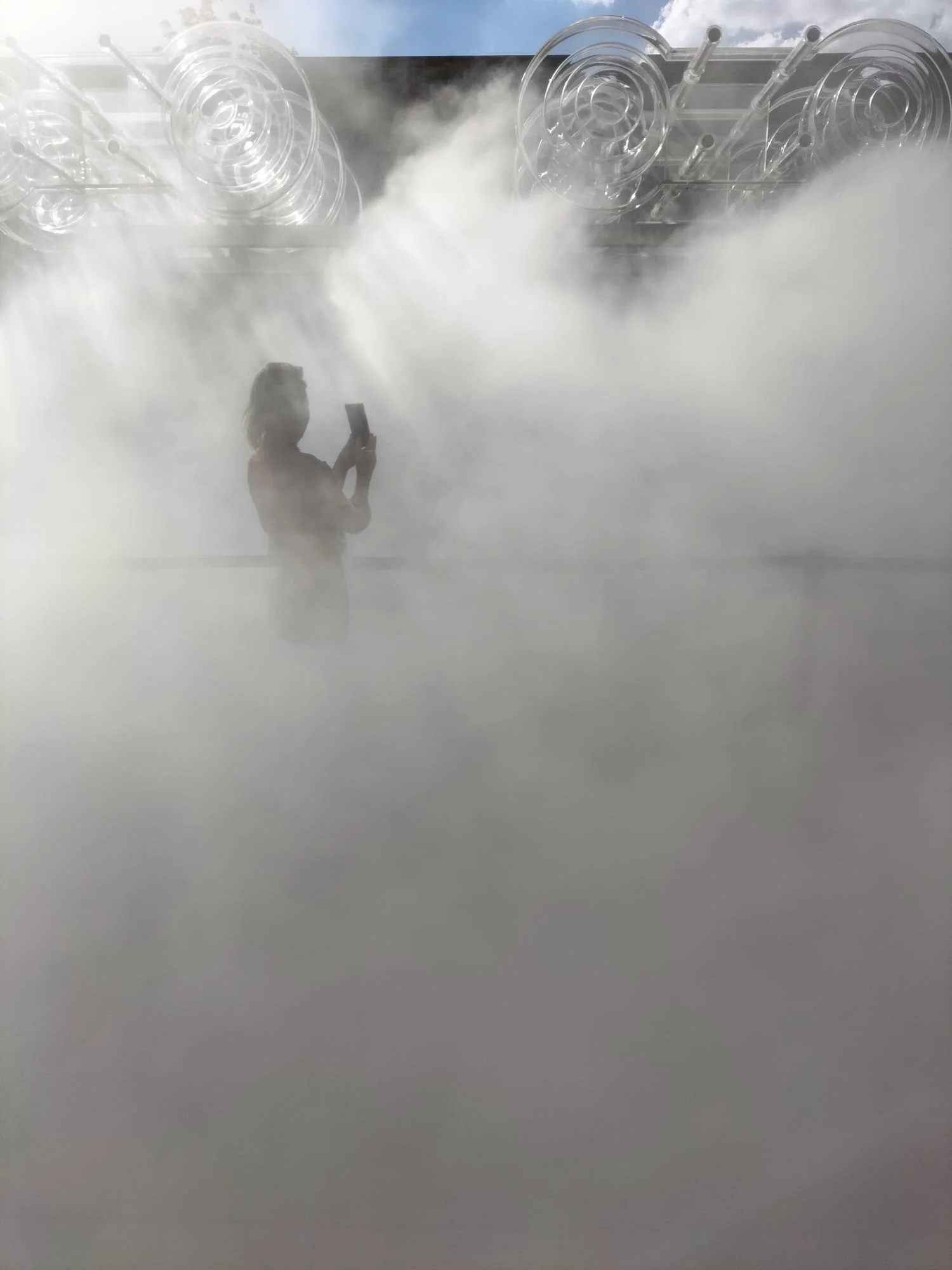
Like 360 degree room, Beauty is an experiential, reverential type work, with a single spotlight shone through a curtain of continuously falling fine mist to create a delicate rainbow that seems ready to evanesce.

As the viewer moves about the darkened room, as small children run gleefully through the water the clarity, vigour and colour of the rainbow shifts and the gentle, meditative shhh of the mist makes for the kind of quasi-religious experience people associate with church and or sunsets.

Olafur Eliasson, Multiple grotto, 2004.

There are other works that warrant mention – Moss wall (1994) and Multiple grotto (2004) being two of them. The organic, fragrant reindeer moss that covers an entire wall appears coral-like and unrelated to the large stainless steel grotto, until you peer into the spiky anemone-like structure: Eliasson has used large mirrors like an angled kaleidoscope to create complex cones based on a unique crystalline pattern found in only nature. And so it is that the spongy moss and the spiky space age steel, visually so divergent, yet poetically, one a microcosm of the other.

Works like Multiple grotto, Beauty and 360 degree room all encourage a sense of curiosity in the viewer and invite engagement, through play, perspective and the use of space. Participation and an active awareness of surround are central to Eliasson’s practice and ‘Take your time: Olafur Eliasson’ offers a thought-provoking opportunity to challenge the way we view the world and to see the landscape anew for ourselves.


OTHER POSTS

REVIEW: Anish Kapoor, Royal Academy of Arts

26 September - 11 December, 2009

Anish Kapoor, Tall Tree and the Eye, 2009.

The problem with ‘blockbuster’ exhibitions is that, amid the tube posters and the street  banners and the Sunday magazine features, you risk not being able to see the art for the  hype. Seeing the Anish Kapoor exhibition at the Royal Academy of Arts in the last week  of its two and a half month run the problem here was not being able to see the art for  crowds. The hype clearly worked, but did the art? Happily, yes it did.

A graduate of the Chelsea College of Art and Design, Mumbai-born Anish Kapoor has  been living and working in Britain since the early 1970s. He represented Britain at the  Venice Biennale in 1990, won the Turner Prize in 1991 and in 1999 was elected a Royal  Academician – Kapoor’s reception here only reiterates his ongoing critical and popular  contribution to the British art establishment.

Challenging traditional notions of sculpture through a physical and psychological engagement with scale, space, colour and texture, Kapoor’s work explores, and consequently reveals, the confrontations and challenges of both sculpture as a practice and sculpture as a material object. The exhibition at the Royal Academy brings together a wide-range of Kapoor’s work from the last three decades and the encounter is, perhaps surprisingly, as diverse emotionally as it is visually.

Approaching any one of Kapoor’s works, be it a wall-infused installation, a free-standing reflective sculpture or an enormous cannon that systematically and destructively heaves large pellets of red wax against the wall, there is inevitably a process of engagement and negotiation, of space and/or expectation, that takes place. Curiosity and participation are key – works must be walked around, ducked under, weaved through or peered at and the response provoked is by turns thoughtful, delightful and affective. And it begins in the courtyard.

Anish Kapoor, When I Am Pregnant, 1992.

Tall Tree and the Eye (2009) is a luminous, seemingly ephemeral work – a series of bubbles or reflective baubles that climb giddily towards the sky. Their shiny reflective surfaces manipulate the scenes about them and their sense of fleeting and weightlessness is only reinforced by the classical and symmetrical architecture of the courtyard. You are drawn in, around and upward – it is an early instruction of things to come and a beguiling introduction to the exhibition.

The first of several rooms holds Kapoor’s collection of pigment works, which he began in the late 1970s. Like delicate but extravagant sandcastles, these red, yellow and black floor-based works belie any human hand such is their precise execution. Their seeming precariousness is at odds with the vibrancy of the pigment and they are fascinating studies of colour and construction but arguably, the more effective piece in this room is the wall work When I Am Pregnant (1992). As the title suggests, When I Am Pregnant is a swollen, unknown volume that emerges seamlessly from the wall. Pregnant with expectation, the work suggests process and indeed plays with this idea of expectation. The bump changes as you navigate your way around it – it can be seen from the side but standing in front of the bump it elusively disappears, a trick of both perspective and light. This subtlety and its visual softness, like the head of a newborn, prompts a surprisingly maternal sensation.

Anish Kapoor, Yellow, 2009.

It is a similarly affective experience standing in front of Yellow (1999), another wall-based work, only here the space is inverted, something you are not fully aware of until standing directly in front of it. It is like looking at a 2D image of a 3D-work as the convex/concave element never quite resolves itself. Again, there is a softness to the gentle curve of the womb-like space and this submersion in colour is strangely both pacifying and slightly disconcerting.

Anish Kapoor, Shooting into the Corner, 2008/2009.

The uses of colour, pigment and curvature gently connect these first two rooms – going left or right from here is quite a departure. Much has been made of Kapoor’s quasi-performance sculptural work Shooting into the Corner (2008/2009). A large working cannon is sectioned off behind a guide rope and a growing collection of pallets, holding empty wax canisters the size of house paint tins is to the left. The cannon is aimed through the doorway of the next room, through which an oozing, carnage of red wax can be seen. Every 20 minutes a gallery attendant loads the cannon with another 9kg pellet and fires it through the doorway, at a clocked 50km/hour. There is much going on in this work, besides the violation of the Royal Academy’s Small Weston Room. Physiologically as viewers there is the waiting, then the nervous anticipation as the cannon starts to tick before the sudden and violent explosion that startles the entire room, despite the expectation.

Intellectually there is something childishly gleeful in seeing an artist like Kapoor literally destroy an establishment that is so hugely a part of that other establishment, the Art Establishment, but overwhelmingly it is the visceral elements of this work that are the most memorable. The deep blood red wax, splattered against the walls and fittings is brutal both in its beauty and its violent associations and it is with a heightened sense of anxiety that the viewer walks away from the entire mise-en-scene.

Anish Kapoor, Hive, 2009.

The comparison then with the room of reflective Non-objects could not be starker. A series of mirrored concave sculptures, these works, with their highly polished surfaces are an exercise in self-conscious spatial awareness that continues the lesson from the courtyard. Reflections are inverted, perverted or altogether vanished and there is a refreshing purity to them after the cannon work. However, their literalness makes them perhaps the most easily overlooked of all the works on display here.

More recent works, such as Hive (2009) and Greyman Cries, Shaman Dies, Billowing Smoke, Beauty Evoked (2008/2009) are more texturally engaging, through their use of Corten steel and cement respectively and Hive is certainly an imposing work, challenging in both scale – it is barely contained by the room – and form, with its unseen empty middle (but for a highly sexual Origins of the World-esque glimpse). The large jostling collection of cement structures, Greyman Cries et al, that sit on pallets filling another whole room, feel unfinished, abrasive and oblique. Perhaps that was Kapoor’s intention but it felt like a hurried finished to what was overwhelmingly a hugely successful exhibition.

Anish Kapoor, Svayambh, 2007.

The last work on show, which ran through three rooms as a sort of spine, was Svayambh (2007), a large block of red wax that moved continuously and imperceptibly along a track, wedging its way through two different arches in the process. The title comes from the Sanskrit word meaning ‘self-generated’ and there is a fatalistic, beautiful sadness to this work as it is irreversibly changed by its unavoidable journey back and forth through the too-small doorways.

More a presence than a physical work, and not just because of its state of flux, Svayambh feels profoundly mortal and as a sculpture-cum-philosophy it engenders an awareness of space and time and our place in both. The work has been described as a ‘manifesto’ in Kapoor’s oeuvre and that could certainly be the case but overwhelming it is a visual and emotional experience that is bolstered by the many other incredible work on display here. Anish Kapoor at the Royal Academy may well be unavoidable thanks to all the hype. It should also be unmissable.


OTHER POSTS