

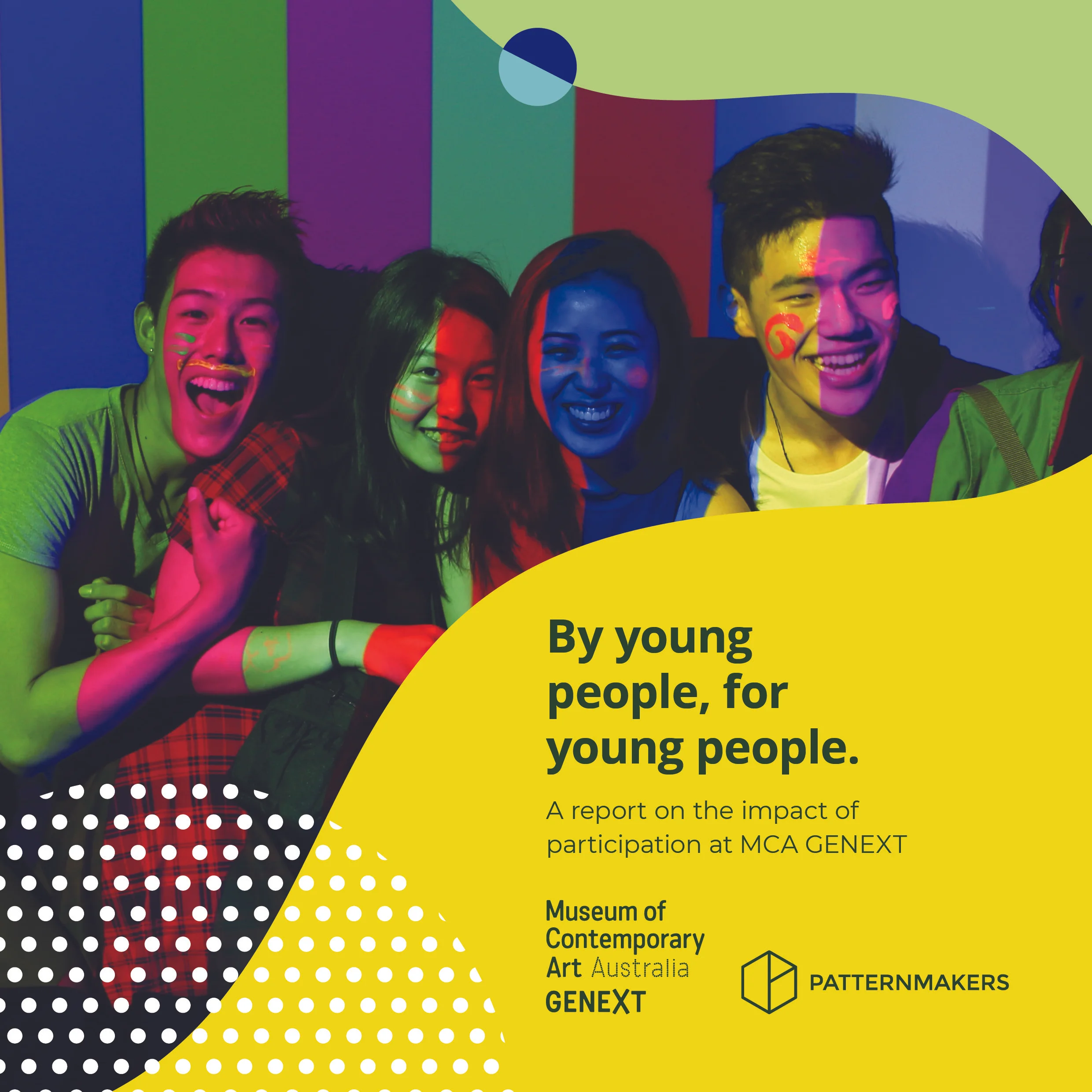
A report on the impact of participation at MCA GENEXT
NSW Churchill Fellow recipients at Government House, 26 October, 2018.
I am so proud to have been named as one of 112 Australians to receive a prestigious Churchill Fellowship this year. This annual award recognises Australian experts who seek to make a positive impact across their professional fields and was established in 1965, the year in which Sir Winston Churchill died. Its principal objective is to perpetuate and honour the memory of Sir Winston Churchill by the award of Churchill Fellowships.
A Churchill Fellowship is the award of an opportunity through the provision of financial support that enables Australian citizens to travel overseas to undertake research, analysis or investigation of a project or an issue that cannot be readily undertaken in Australia.
The fellowship offers the opportunity to visit other countries and investigate inspiring practices that will benefit Australian communities. In 2019, I will be travelling across the US and Canada for eight weeks, visiting institutions including the Whitney Museum of American Art, New York; the Walker Art Centre, Minneapolis; MCA Denver; and Art Gallery of Ontario, Toronto.
Young people lining up for GENEXT, April 2012, the MCA’s flagship event for young people aged 12-18. The program is developed and run by the Museum’s Youth Committee. Image courtesy: MCA Australia.
I’m going to be investigating different models of youth-led engagement and informal & peer-to-peer learning programs for young people 12–25 years. These kinds of art- and museum-based programs, which are similar to the ones I run at the MCA, put the ideas and experiences of young people at their centre.
I’m so excited to learn more about these programs because they’ve been proven to have significant long-term impacts on participants, including improved mental health, increased empathy and creative and critical thinking skills, as well as developing lifelong connections to the arts. But these learnings are not just for the benefit of young people – they benefit the arts sector too; it’s vital we find ways to support and engage this audience because they’re our future makers, designers, artists, curators and ambassadors.
The research and travel is obviously a huge part of the Churchill Fellowship but working towards making an impact with your findings on return to Australia is the long-term aim and for me, that means supporting the growth of peer-led youth programming within Australian institutions. As part of my application, I undertook a lot of research here in Australia and affirmed that a lot of the youth programming that takes place in cultural organisations here is currently delivered by adults (that is, it’s not peer-led). This is slowly changing but there is little longitudinal experience or institutional knowledge on a national level in this area, outside the MCA, which is why the Churchill Fellowship is so exciting. My research across the arts sector here reveals a huge desire to work with young people in meaningful and sustainable ways, but there’s a lot of uncertainty about how to begin – and how to sustain it, once you do!
Obligatory Churchill selfie, London, September 2018.
Some of the programs in the US and Canada have been running some phenomenal youth-led programs for more than 15 years nows. I’m really looking forward to meeting with educators, public programmers and participants and to observe these programs first-hand; to find out what makes them so successful and why they’re so important – to the museums that support them, but also to those young people who participate in them.
It’s going to be a life-changing experience.
In 2016 I was approached by Dr Kim Snepvangers at UNSW Art & Design and invited to contribute a chapter to Beyond Community Engagement: Transforming Dialogues in Art, Education and the Cultural Sphere, part of the UNSW Curated Series: Transformative Pedagogies in the Visual Domain.
With a focus on peer-led learning and institutional partnerships, I approached my former South London Gallery colleague Sarah Coffils, now SLG Head of Education, to co-write the chapter with me, which we titled “Collaboration or Cooperation: Peer-led Learning and Institutional Partnerships through Two Case Studies.”
We took a dialogic approach to framing the chapter and called on past project collaborators and several key academics in the field of peer-led learning to contribute their reflections, which they did generously and openly.
That was 2016. And then edits and re-writes and publishing hold-ups meant nothing… until now. Finally: it’s here.

I’m really proud of what Sarah and I wrote and am so grateful to Kim for the opportunity to take on this challenge and for her critical, constructive, encouraging feedback along the way.
The book can be purchased here (if some light academic reading is your thing) but the Abstract to Sarah’s and my chapter is copied below.
ABSTRACT:
This chapter explores from a practitioner-based perspective, two recent arts projects, that employed peer-led and project based models of learning to engage with a specific audience of young people aged 13-25. While distinct in their organisational structure, duration and delivery, both projects were conceived as part of unique institutional partnerships that engaged artists, creative industry practitioners and curatorial and educational peers as central to each projects’ realisation.
The two case studies include a UK project called the Louis Vuitton Young Arts Project (LVYAP) that was conceived by the South London Gallery and ran from September 2009 – March 2013 in partnership with the Tate (across both Tate Modern and Tate Britain), Whitechapel Gallery, the Hayward Gallery and the Royal Academy of Arts. Both authors worked on this project. The second case study is from Australia and is the Kaldor Public Art Projects Pilot Regional Engagement Project, which in contrast with the LVYAP, ran for a shorter period of just 12 weeks, from May to July 2015. The project was part of the educational program for Project 30 – Marina Abramović: In Residence . It was delivered in partnership with the Western Plains Cultural Centre in Dubbo in central western NSW with support from regional arts board Orana Arts. One of the authors, Jo Higgins, worked on this project.
Using a dialogic conversational format to reflect on what worked and what didn’t in these two projects, the authors’ explore the institutional nature of collaboration, as something distinct from cooperation, and considers the role of agency and outcomes for both facilitators and participants in understanding what may constitute success. The relative successes of each project are considered in light of Australian and International evaluative reports on peer-led learning and shifting cultural agendas as well as key academic texts on collaboration and models of museum-based learning.
Ultimately, we attempt to draw some conclusions about best practice models of working in regards to institutional partnership projects and innovative engagement programs that target a specific audience of young people; an audience that necessarily needs to be nurtured if cultural institutions are to have vital and engaged future audiences.
I am so excited to be starting a new role this week at the Museum of Contemporary Art Australia.
As Young Creatives Coordinator I am going to be managing all their youth-led programs, including their Young Guides and the MCA’s Youth Committee, who are responsible for programming the Museum’s flagship event for young people 12-18, GENEXT.
GENEXT has been running since 2005 and is the only program of it’s kind in Australia - both in terms of longitude and scale (upward of 600 teenagers attend this five-times yearly event) , but also in terms of its informal, peer-led learning approach. It’s a program I’ve been following since before I left London so it feels like a bit of a dream to be running it now.
I’ll also be responsible for programming their monthly Lights On Later workshop series. There’s so much to look forward to.
Oh, and getting to work in such an iconic location, right on Circular Quay, under the gaze of the Harbour Bridge and across from the Sydney Opera House is also not going to suck.

Photo: Pieter Naessens.
In April this year I started working part-time at the Australian Design Centre, in the wonderfully nebulous, newly formed position of Creative Strategy Manager. ADC has been around for more than fifty years now – it began it’s life as the NSW Craft Council back in the 1960s and over the decades has made some extraordinary contributions to the craft and design landscape of Australia. The opportunity to contribute to the organisation’s development at a moment of re-visioning and to bring my ideas and experiences and passions for making and education and partnerships was too good to be true. And then three weeks later we were one of the 100-plus arts organisations to lose our four-year core funding from the Australia Council for the Arts.
It was like being sucker-punched.
Yes, I despaired for the organisation – but mostly, that instinctive, from-the-gut howl of despair that engulfed me was the feeling, yet again, that the arts don’t matter. And that by extension, the things I stand for, the way I see the world and the way I understand the arts to be a vehicle for critical discussion, enlightenment, learning and community also didn’t matter. As Alison Croggon writes so deftly and angrily and articulately for The Monthly, “Part of the exhaustion of being an arts worker in Australia is that our very existence is continually in public question.” She articulates the fibres of every thought and emotion from the last six months of soul crushing keeping on carrying on with extraordinary eloquence. I can’t recommend her article enough and implore you to read it in full here.
Because she says it so much better than I ever could, I have re-posted sections of it below. Because now more than ever we need to be championing every dissenting, elegant, intelligent, critical voice we can. Thank you Alison.
“Culture Crisis: The arts funding cuts are just a symptom of a broader malaise in Australia.” Alison Croggon, The Monthly, October 2016.
“The despair that characterises so much present discussion about our cultural future is about much more than money. What has been clear for years is that in general public discourse – as opposed to the preferences of actual Australians – culture is a trivial consideration. Part of the exhaustion of being an arts worker in Australia is that our very existence is continually in public question. Again and again, we have to assert presence and value. It is impossible to simply assume that culture is a common good: it must be constantly argued.
Outside the specialist world of arts discussion, Australia has two modes of talking about culture and art: the mockery from right-wing columnists who regularly attack artists (as well as other knowledge workers, such as scientists and university researchers), and the bathetic motherhood statements about art’s intrinsic worth that roll readily from the mouths of politicians. Art is considered a leisure activity, a luxury for an elite, an entertainment in the most reductive senses of the word, a value-free product.
Advocates even point out the economic benefits of a healthy culture, to combat the erroneous but widespread perception that it contributes nothing to the economic bottom line. (For the record, culture is a bigger industry than agriculture, and employs many more people than the mining sector.) But the danger is that these secondary issues become the primary justifications, erasing the reasons why culture actually matters.
Again and again, public discourse about art has taken the road of least resistance, preferring to shore up the status quo rather than to question, to expand, to educate, to inquire, to imagine better.
Criticism is a crucial part of making a culture. Critical discussion in all its manifestations – from the casual tweet to the considered academic essay – is the hinge that links an artwork to a public. Critique is what connects one work to another, and to the contexts – the histories and social meanings – that inform it. Argument is how we hammer out the value of a thing, creating over time a complex weave of consensus and disagreement. A healthy critical culture welcomes the new and strange, inviting those who might feel hesitant to step confidently into the rewards of not knowing.
Do we have this kind of public discussion in Australia? We do, but it scarcely exists inside our major media institutions. It’s fostered in small companies, on blogs, in forums and discussions that exist on the margins of mainstream discourse. Over the decades, our mainstream critical culture has failed to convince us – the public, our governments, even artists themselves – of the value of culture in our daily lives. It has failed to articulate why Australian art might matter as a public good, to individuals and to a broader society. And now, as Australian culture faces its biggest crisis, that failure is tragically manifest.
Under the newly constricted funding, small organisations and individuals – the sources of our most robust critique – are those who are most at risk. With a few noble exceptions, it’s always been those with the least institutional heft who have been the most outspoken. Indeed, small organisations and artists, rather than our well-resourced institutions, have driven almost all of the political heavy lifting in the turmoil of the past year. Just as the larger companies rely on the poorly funded independent sector to take the creative risks that generate new ideas and new talents, so the smaller organisations and individuals are those expected to stick out their necks to defend the whole.
It was grassroots-driven activism that had sparked a Senate inquiry, which attracted 2719 submissions from every section of the arts community, held hearings in every state and territory, and put the arts firmly, and for the first time, on the agenda in the 2016 election.
Likewise, our major media outlets have for decades relegated the arts to a fenced-off playpen, a subset of the entertainment section. The Walkleys, the premier awards for Australian journalism, have never acknowledged cultural journalism or criticism as they do, for example, the equally specialist journalism of sports coverage. In the newsroom, the arts have always been poor cousins, begging for space. The ideas that drive our best artists, the passion that informs their work and their desire to speak about this world, almost never make it into print or pixels except as bowdlerisation. There isn’t the space.
…..And yet we need a strong critical culture now more than ever.
The critic is the person who makes a major part of the public argument for culture. It is a critic’s job to discover and to advocate for new and exciting work, to estimate its success or failure, to elaborate its genesis, to call to account, to argue for worth and unworth. Ideally, the critic exists as part of a web of diverse voices, where differences of response can be adumbrated and explored. This dynamic interweave of argument is how a culture is made: as Mexican critic and poet Octavio Paz said, criticism is what makes connections and histories, a culture. Without criticism, what you have is just a whole lot of art.”
I live and work on the unceded lands of the Gadigal and Bidjigal people and acknowledge their unbroken connection to this Country. I pay my deepest respects to their Elders, past and present, because this always was, and always will be, Aboriginal land.